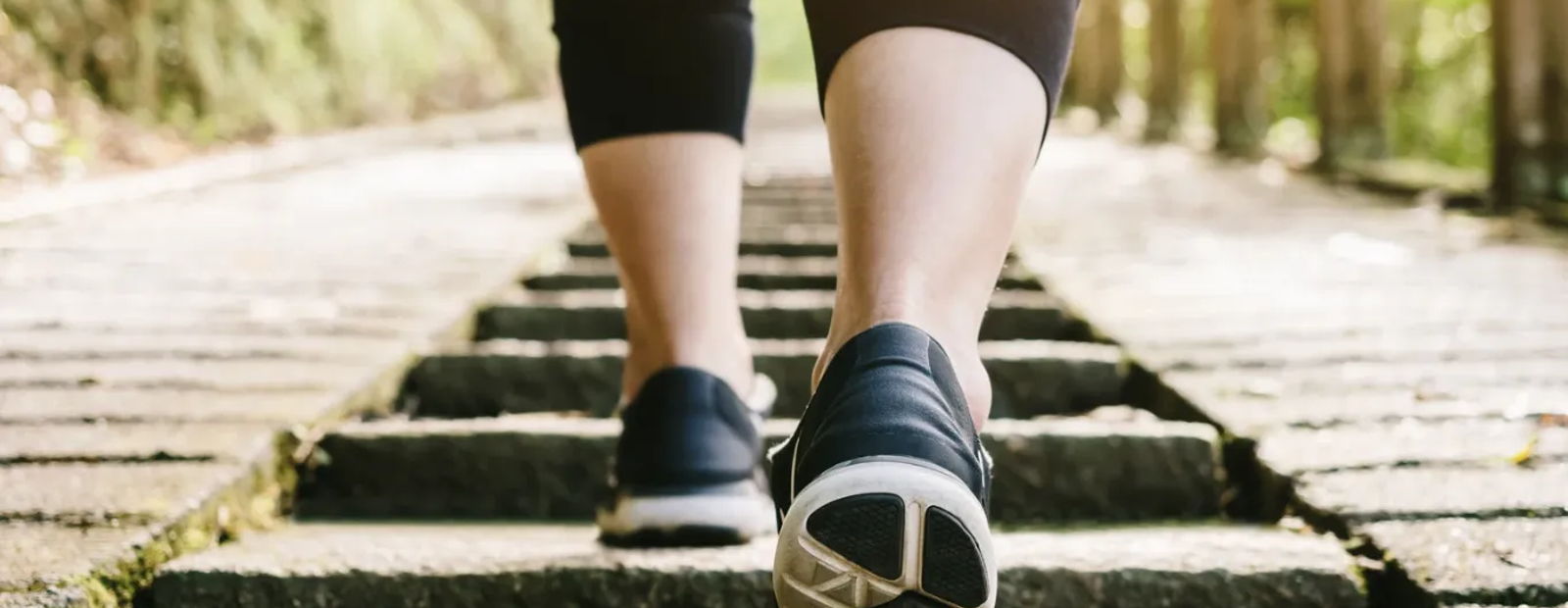
Knee pain that shows up hours or days after exercise is one of the most confusing experiences people have with their knees.
Many people feel fine while squatting or exercising—only to notice knee pain later during daily activities, walking, or when taking the stairs.
This delayed knee pain isn’t random. And it has a clear explanation.
Here’s what my client told me recently as we started working together:
“Something that I have found kind of tricky about my knee pain is that sometimes I'll feel okay on the day that I do an activity.
“Like the day when I'm doing squats, I might feel like, ‘Wow, this is going great.’”
“And then the next day, or the day after, I'll notice more often feeling pain in my knee when I’m taking the stairs. Or when I’m walking up an incline sidewalk.”
“It’s an intermittent knee pain. It's not every step, but I'll just notice it – kind of like a day or two or three after I've done the leg exercises, trying to build up my strength.”
*If you’re trying to understand why this happens, this article explains the underlying issue
“So it's been hard for me to tell what level of activity is sort of therapeutic for my knee versus, when I might not be not making it better, you know?”
This describes a perfect storm:
- delayed pain,
- unclear cause-and-effect, &
- no reliable way to know what’s actually helping.
It’s particularly frustrating if you want to take good care of your knees.
Or if you want to avoid repetitive symptoms and harm that could lead to a knee replacement.
The hardest part isn’t the knee pain itself.
It’s not knowing whether what you’re doing is helping your knees… or quietly making them worse.
If you immediately felt knee pain, you would know to stop doing whatever you were doing in that moment.
But instead it can feel like your knee pain is random.
Two Types of Leg Strength that Affect Knee Pain
Activities like walking, descending stairs, rising from a chair, and squatting all place load on your knees — even when your movement quality and alignment are good.
Your leg muscles determine whether you can perform these activities.
If your muscles are sufficiently strong, you can squat without difficulty.
If your muscles are weak, you’ll feel fatigue and eventually struggle to complete the movement.
No matter how strong you are, your muscles still have a limit.
For example, you might be able to sit down and stand up from a chair easily.
And you might also be able to squat at the gym holding weight — maybe 10 pounds, maybe 110 pounds.
But if you continue increasing the load, you’ll eventually reach a point where your muscles can no longer maintain good alignment, and the movement breaks down.
This is one type of strength: muscle strength.
But muscle strength alone is not enough.
There is another limiting factor that matters just as much — and often more — when knee pain is occurring: inner knee strength.
When I say “inner knee strength,” I’m not talking about your quads or glute muscles.
I’m talking about how much load the structures inside your knee can tolerate.
These structures include your synovial fluid and your cartilage.
When the structures inside your knees are sufficiently healthy and strong, they can tolerate the load from your daily activities and exercises without resulting in knee pain, stiffness, or swelling. (source)
But when your inner knee structures are not strong enough, your knees may become irritated — even if your muscles are strong enough to complete the movement with good form. (source)
In other words:
Muscle strength determines whether you can do an activity, like squatting, with good alignment or form.
Inner knee strength determines whether your knee tolerates it afterward, or if instead you get more knee pain, stiffness, or swelling.
The challenge is that it’s often hard to know — in the moment — how much load your knees can safely withstand.
And this is why knee pain often doesn’t show up when you expect it to.
Why Knee Pain Often Shows Up Hours or Days Later
To understand why knee pain often shows up later, we need to talk briefly about what your knees can—and can’t—feel.
You can feel when your muscles start to get tired — before your muscles are being strained and before muscle damage occurs.
You can also feel light pressure on your skin, or sudden impact.
This is because both muscles and skin have nerve supply.
The nerves provide immediate information to your brain.
But not everything in your body has nerve supply.
The surfaces inside your knees — the cartilage on the ends of your bones — don’t have nerve supply. (source, source)
That’s why you don’t get real-time feedback from inside your knee.
Instead, when an activity or exercise overloads your inner knee surfaces (your cartilage), damage may occur silently.
Until this damage causes irritation to nearby tissues that do have nerve supply.
You have a joint capsule that surrounds and supports your knee.
The lining of this joint capsule is known as the synovial membrane (pictured below in red).

What Delayed Knee Pain Means for Your Knees
If your knee pain shows up a day or two after activity, you’ve probably tried to manage it in one of two ways:
You either rest until it settles down…
Or you avoid the activities that seem to trigger it.
Both can help your knee feel better temporarily.
But neither changes what your knee is actually capable of handling. (source)
Why ‘Good’ Exercises Still Cause Knee Pain Later
So when you return to your normal activities — stairs, walking, squatting, and other leg exercises — your knee pain eventually comes back.
This is because knee pain isn’t determined by whether an activity is “good” or “bad.”
Instead, knee pain is determined by whether the load from that activity exceeds your knee’s current capacity to withstand the load. (source)
Everything you’ve read so far comes down to one concept.
This is what I call Load Tolerance.
What Is Load Tolerance? (and Why It Matters for Knee Pain)
Load Tolerance describes your knee’s ability to withstand force — from walking, stairs, exercise, or daily life — without resulting in pain, stiffness, or swelling.
When the loads placed on your knee remain below your current Load Tolerance, your knee feels fine.
When those loads exceed it, knee symptoms appear or worsen.
This framework explains why knee pain after exercise can feel so unpredictable.(source)
How Load Tolerance Actually Increases
Your knees aren’t passive structures that wear down simply because you use them.
They are living tissues that respond to the loads placed on them.
When the structures inside your knee are exposed to appropriate, repeated loading, they receive a signal that says:
“This level of force is required. We need to be able to handle it.”
In response, the tissues inside your knee begin to adapt.
This process — known as mechanotransduction — is how physical load is converted into biological change. (source, source)
In simple terms:
The right amount of progressive load tells your knee to become more resilient.
Over time, this raises the threshold at which symptoms appear.
Why Guessing Your Knees’ Limits Backfires
The problem isn’t loading your knees.
The problem is loading your knees without understanding how much they can currently tolerate.
Too little load, and there’s not enough of a signal to adapt.
Too much load, and the tissues become irritated instead of stronger. (source)
This is why conventional exercise programs often fail people with knee pain.
They may improve muscle strength, but they don’t consistently deliver the right load — at the right dose — for the right amount of time.
Rest lowers the load temporarily, which can reduce symptoms.
But it doesn’t increase your knee’s ability to tolerate load. (source)
Key Takeaways
- Delayed knee pain after exercise isn’t random — it’s a predictable response to exceeding your knee’s current Load Tolerance.
- Muscle strength and your knees’ Load Tolerance are not the same thing. You can squat well and still overload your knee internally.
- Cartilage doesn’t give real-time feedback, so damage can occur silently and show up days later as soreness or stiffness.
- Rest and symptom relief don’t increase knee capacity — they only reduce load temporarily.
- Lasting knee improvement comes from increasing Load Tolerance, not avoiding activity or guessing what’s “safe.”
Frequently Asked Questions about Delayed Knee Pain
Why does my knee hurt days after exercise but not during?
Because the load-bearing surfaces inside your knee don’t provide real-time feedback. When load exceeds your knee’s current tolerance, irritation shows up later.
Is knee pain after squats a sign of damage?
Not necessarily. It’s often a sign that the load exceeded your knee’s current Load Tolerance—not that the exercise was “bad.”
Should I stop exercising if my knee hurts later?
Stopping may reduce symptoms temporarily, but it doesn’t increase what your knee can tolerate. Long-term improvement requires progressive, appropriate loading.
Related Articles

For personalized guidance to build Better Knees:
Schedule a free 20-minute Strategy Session. (Find your best time here.)
Disclaimer: The information in this blog post is for educational and informational purposes only and is not intended as medical advice. It should not be used to diagnose, treat, or prevent any health issue or disease without consulting with a qualified healthcare professional. The author of this blog and the website do not bear any responsibility for any actions taken based on the information provided in this blog.
Disclaimer: Disclaimer: The information in this blog post is for educational and informational purposes only and is not intended as medical advice. It should not be used to diagnose, treat, or prevent any health issue or disease without consulting with a qualified healthcare professional. The author of this blog and the website do not bear any responsibility for any actions taken based on the information provided in this blog.
Related Posts

"You Can't Make Your Knee Any Worse": Why That Common Surgical Advice Isn't Accurate
Common knee surgery advice can overstate risk. Learn why “you can’t make it worse” is an oversimplification—and what helps sensitive knees.

My Shoulder Hurt for Months — Then I Did a Pull-Up. Here's What That Has to Do With Your Knees.
The body often adapts before symptoms improve, which is why people quit their recovery too early. Tracking objective measurements like knee joint Load Tolerance helps bridge the gap between what you feel and what is actually changing. This is the foundation of the Insid
PRP for Knee Pain: An Honest Look at the Evidence
PRP (Platelet-Rich Plasma) injections are among the most debated treatments for knee osteoarthritis. Research suggests PRP can reduce pain and improve function — but platelet dose, preparation protocol, and patient selection significantly affect outcomes. Most important